IESE vs Stanford: Two 2026 Search Fund Studies Side by Side
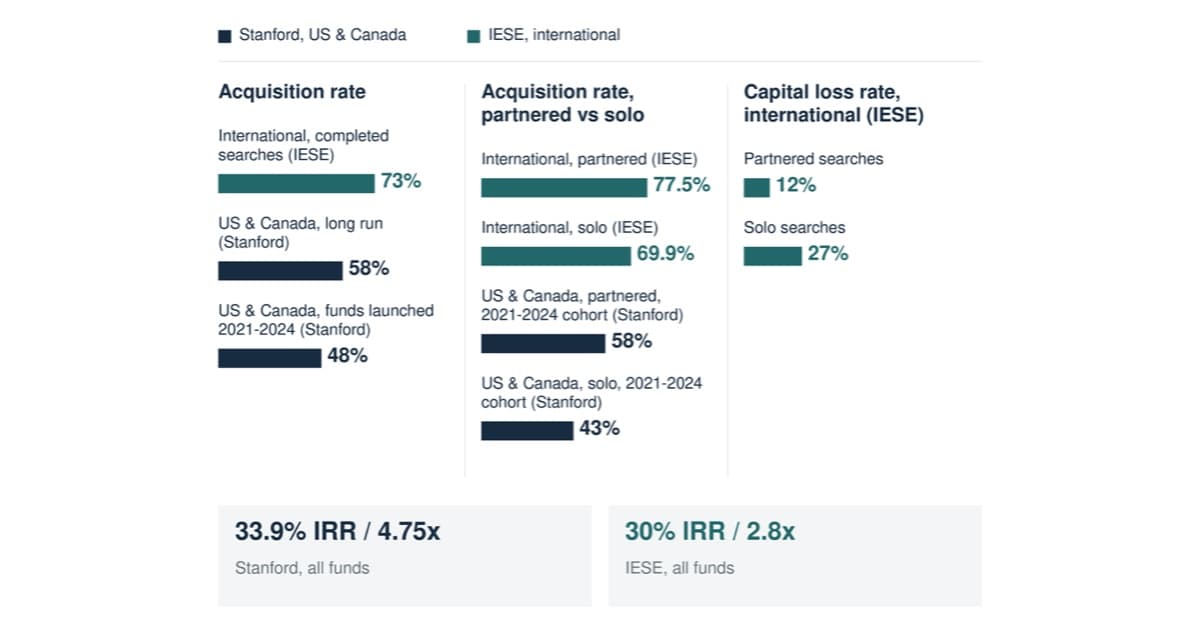
Stanford and IESE 2026 search fund studies disagree on acquisition rates and returns, but agree on what matters: speed to a first LOI and a second searcher.
Comprehensive research on the self-funded search asset class — backed by 40 years of data and 681 fund track records


681 search funds tracked since 1984. 35.1% IRR and 4.5x ROI across all funds. 42.9% IRR for exited companies.
Independent sponsor structures provide cleaner alignment: 82% target $5-50M EV, 73% require sponsor equity contribution.
Data shows diversified portfolios of 20-30 positions produce more reliable outcomes than concentrated bets.
Deal terms converging toward lower leverage, cleaner structures, and better LP alignment across the asset class.
The data on self-funded search is compelling. We've allocated 5% of our alternatives sleeve to SMB co-investments.
The governance structure and operator alignment in independent sponsor deals addresses our key concerns about smaller-check investing.
What attracted us was the cash flow profile. Unlike venture, we receive distributions during the hold period.
Stanford and IESE 2026 search fund studies disagree on acquisition rates and returns, but agree on what matters: speed to a first LOI and a second searcher.