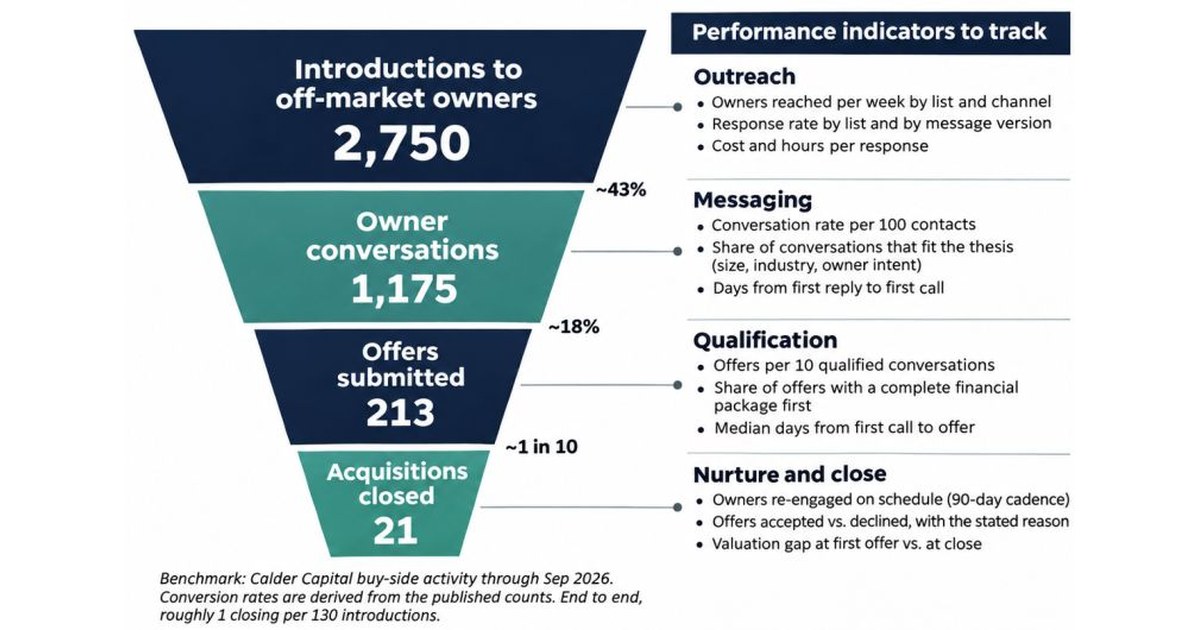
For anyone running a proprietary search, Calder Capital's Q3 2026 lower middle market update is worth looking at for benchmarking purposes. It's one firm's numbers, but it provides a rare look at an off-market funnel from a best-in-class group that runs buy-side search at scale.
The funnel
Calder's buy-side activity through September 2026:
| Stage | Count | Conversion from prior stage |
|---|
| Introductions to off-market owners | 2,750 | |
| Owner conversations | 1,175 | about 43% |
| Offers submitted | 213 | about 18% |
| Acquisitions closed | 21 | about 1 in 10 |
End to end, that is about one closing per 130 introductions.
One caveat before you benchmark: this is a well-resourced team working a database across many clients. An introduction here is likely to convert better than a solo searcher's cold email. I would treat the ratios as a ceiling to measure against, not a target you should expect to hit in year one.
Owners are window shopping
On the sell side, Calder's information requests were up about 7% and valuation deliverables up 12% this year, while signed engagements were down 24%. Owners are asking what the business is worth, and a larger share of them are then deciding not to go to market.
Axial's July survey of 79 lower middle market dealmakers points at why: 57% named valuation expectations as the single biggest reason deals failed to close in the first half of 2026, up from 28% for deals that failed in 2025. We saw the same gap from the other side in our comparison of LOI prices and closing multiples.
Takeaways for a proprietary search
Benchmark each stage, not just the total. If your introduction-to-conversation rate is well under 40%, the problem may be targeting or messaging. If conversations are not converting to offers, the problem might be qualification, your nurture approach or expectations. A single "deals closed" number hides which stage is leaking.
Size the top of the funnel, and expectations, appropriately. One closing per roughly 130 introductions means a two-year search may need hundreds of real conversations, not a few dozen.
Expect more window shopping. Valuation requests up and engagements down means a larger share of the owners you reach may want to discuss numbers before they want a process. That has nurture implications: plan to stay in touch with owners for longer before they are ready to transact.
Lead with structure when price stalls. Calder lists cash at close, financing, working capital, seller notes, earnouts and rollover equity as the levers that get parties to agreement. Most valuation gaps are closed through deal structure, and that rings true with our experience.
Run sourcing like a business
We frequently tell buyers to run deal sourcing like a business. That means a small set of performance indicators that track how effective your outreach, messaging and nurture activities actually are. Review them on a cadence, the way an operator reviews a sales pipeline, and report them to prospective investors or partners.
A starting set, by stage:
- Outreach: owners reached per week by list and channel, response rate by list and message version, cost and hours per response.
- Messaging: conversation rate per 100 contacts, share of conversations that fit the thesis (size, industry, owner intent), days from first reply to first call.
- Qualification: offers per 10 qualified conversations, share of offers with a complete financial package first, median days from first call to offer.
- Nurture and close: owners re-engaged on schedule, offers accepted versus declined with the stated reason, and the valuation gap at first offer versus at close.
Calder's funnel provides one example to measure against: four numbers, three conversion rates, and a clear view of which stage is leaking. For investors, a searcher who can show you these numbers is showing you how they will run the company. Our earlier piece on why proprietary sourcing matters covers the pricing side of the argument, and Getting the Deal Over the Line covers what else separates the buyers who close.
What best practices are others using to manage proprietary deal sourcing? If you want our deal sheet and future benchmark notes, join SMB Investor Network at smbinvestornetwork.com.
Sources