This piece was prepared by Kodiak Holdings and Search Fund Ventures, based on data from external and internal studies. It first went out in The SMB Investor newsletter and on Kodiak's Substack.
Every year, a growing number of entrepreneurs and independent sponsors pursue the acquisition and operation of established small businesses, contributing to a market with thousands of active buyers. Acquisition entrepreneurship in the lower middle market is expanding quickly because of generational transitions, attractive entry prices, durable cash flows and AI transformation opportunities within America's small business backbone.
The reality, however, is that many of these deals never close. Stanford's 2026 Search Fund Study puts the acquisition rate for recently concluded core search funds at 48%. Roughly half of recent searchers end their process without a company, and we suspect many independent sponsor transactions face similar challenges in capitalizing and closing. For what a search that ends without a deal means for its investors, see what broken searches mean.
This piece looks at what separates the half that gets a deal over the line. We drew on the Stanford study, independent sponsor surveys from McGuireWoods and Citrin Cooperman, and data from Search Fund Ventures (SFV) and Kodiak.
The encouraging news is that not all of it is fixed at the start. Stanford's recent data and our internal analyses suggest that what distinguishes the buyers who close includes which acquisition model fits their background, what they buy, who they buy it with and how they run the process.
Match the model to your background
In Stanford's latest study, the typical new searcher is 32, holds an MBA and comes from consulting, private equity or investment banking. The more interesting story is how the talent pipeline has diversified:
- Private equity veterans made up over 30% of first-time searchers as recently as 2012–13. They are about 18% of the 2024–25 cohort.
- Consulting has moved the other way, from 7% in 2008–09 to 19% today.
- The military has gone from essentially zero to 7%.
The entry pool has widened well beyond investors. A wider pipeline means buyers arrive with very different toolkits, and those toolkits tend to sort people into a model. In SFV's deal flow, the people who want to buy a business and run it day to day, which is what we typically define as a search deal, mostly come from corporate finance, operations and consulting. People raising capital as independent sponsors primarily come from investing and M&A. Kodiak's portfolio leans the same way: about two-thirds of the groups Kodiak has backed include a team member with private equity, banking or other investing experience.
That sorting makes sense. An independent sponsor deal is a private equity strategy: the sponsor develops a thematic approach, sources targets, underwrites and negotiates deals, raises the equity and manages the board after closing. Sourcing, diligence, underwriting and capital formation are exactly what a few years in institutional private equity teach. In Kodiak's portfolio, every independent sponsor deal to date, including committed capital vehicles and long-term holding companies, had at least one principal who came up in private equity or another investing seat.
If your background and your chosen model don't line up, the usual fix is a partner. An operator who wants to sponsor deals should typically partner with someone who has sourced, underwritten and syndicated them. An investor who wants to search and run a company should consider working with someone who has managed people and a P&L. The sponsor teams Kodiak backs most often look exactly like that: an investor paired with a former operating executive, a prior search CEO or an industry veteran.
Credentials matter, but less than fit and preparation. Only half of the principals Kodiak has backed hold an MBA, and per Stanford, ETA coursework is increasingly common among new searchers: 61% now take an ETA course before launching, up from 37% four years earlier.
For how the two models differ for investors, see search funds vs. independent sponsors.
Buy next door to what you know
How much experience you need depends on the model. In Stanford's data on traditional search, the bar is a few years: searchers with more than two years of post-graduate work closed at 55%, against 40% for those with a year or less.
On the independent sponsor side, principals typically raise capital one deal or strategy at a time, and investors want a longer track record. No hard rules exist, but the portfolio data is telling: in Kodiak's closed transactions, 74% of principals had 10 to 17 years of experience, and 72% of SFV's backed principals had more than ten.
Research on hiring points the same way. Frank Schmidt and John Hunter's landmark meta-analysis, still one of the most cited studies of what predicts job performance, pooled 85 years of research. It found that experience predicts performance early in a role and then levels off, while how quickly someone learns and how well they do the actual work predict far more.
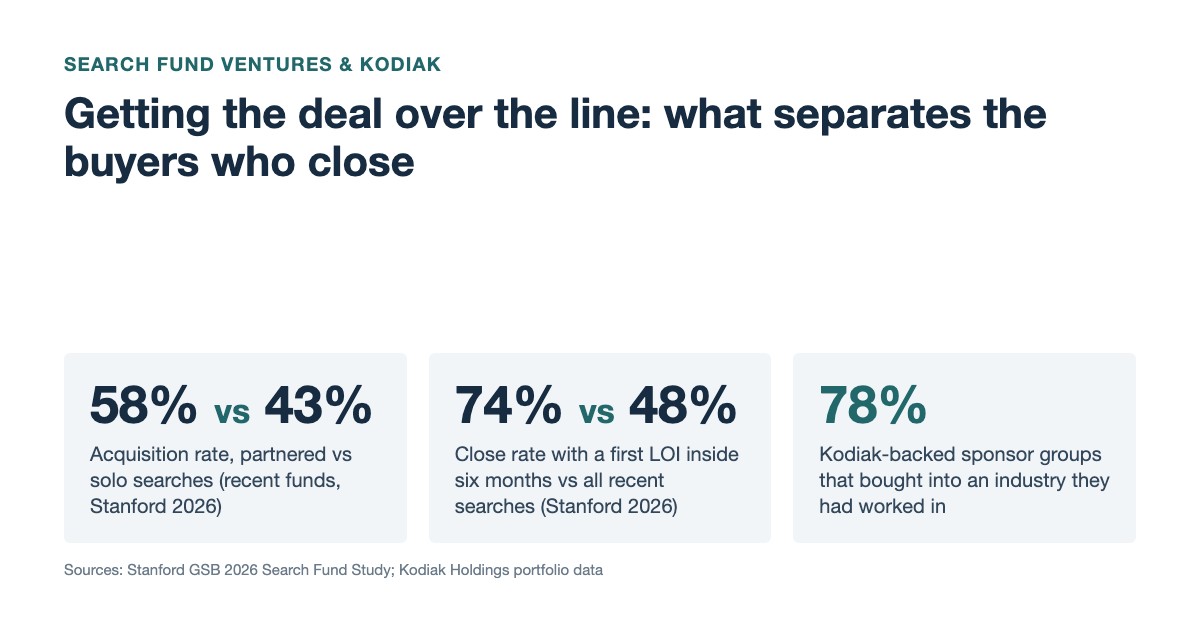
Where experience was earned matters more than how long it runs. In Kodiak's portfolio of completed acquisitions, 78% of sponsor groups bought into an industry they had worked in directly or tangentially. That proximity pays off throughout a deal. It shortens diligence, builds credibility and trust with sellers, and makes operational initiatives more real to investors.
Another useful finding is how first-time buyers get there:
- Repeat principals tend to buy in a sector they already know. Every repeat group Kodiak has backed did.
- First-timers mostly win through adjacency. Of the first-time groups in Kodiak's portfolio, about 15% had direct industry experience and about 85% came from a related function, customer base or industry: a consultant who spent years on factory floors buying a contract manufacturer, or a home services investor buying a residential installer.
That is a practical way to build an acquisition thesis. Start from the skills and relationships you already have, then look one step over for compelling adjacent opportunities. "I've spent a decade fixing plant operations" is a far easier story for a seller and an investor to underwrite than "I'm open to any good business."
Pick a partner who covers your gaps
In Stanford's data, partnered searches acquire a company at a meaningfully higher rate: 58% against 43% for recent funds. On the sponsor side, teams are the norm. Citrin Cooperman finds that 74% of independent sponsor firms have two or more principals. About two-thirds of the sponsor groups Kodiak has backed are teams, and 91% of the deals SFV has backed were led by partnered teams.
Stanford's returns data adds a useful wrinkle. Among searches that did acquire a company, partnered teams were far more likely to land in the 5x to 10x range (27% vs. 12%), yet they reached 10x at about the same rate as solo searchers (9% vs. 8%). A partner was associated with higher odds of a good outcome, but outliers can and do come from both. IESE's international data shows a similar pattern; see our side-by-side read of the 2026 Stanford and IESE studies.
Partnering tends to work because it expands the surface area where a buyer group excels. A second principal covers the gaps every operator has, splits the load of a long search, and gives sellers and investors more than one person to back. The partner who helps most is usually the one least like you. Two former bankers can share the same blind spots.
Non-partnered buyers close deals too, and a third of the sponsors Kodiak has backed are solo operators. The ones who do well tend to replicate what a partner provides in another form:
- Extensive command of their target industry
- A record of prior deals
- A board and advisor bench assembled before close
- Strong alignment with sellers, through equity rollovers, seller notes and post-close transition plans
Run a process investors can back
Experience, industry exposure and partnerships are heavily represented in our closed portfolios, but much of the battle in getting deals over the line sits in selection and process management. In SFV's dataset, sponsor deals were most often passed on for investor terms and purchase price. Search deals were most often passed on for the quality of the business itself.
All three are within a buyer's control, and investors read each of them as evidence of how the buyer will run the company.
Terms are a signal. Terms for sponsor deals have converged on a recognizable market, documented by McGuireWoods and Citrin Cooperman: an 8% preferred return, tiered carry of 20% to 30% and modest closing and management fees. When terms match the market, the conversation moves to the business. When they don't, it moves to the sponsor.
Terms fall in tight bounds because investors in this asset class are typically solving for three things: downside protection, supported by the durable cash flows of acquired small businesses; a path to an attractive base case return; and upside convexity that can turn a good outcome into a great one. Compared with venture capital, independent sponsor and search fund structures place a higher burden on baseline performance to return invested capital before the sponsor earns a piece of exit proceeds. The incentives scale with performance, though, awarding outsized ownership for outlier outcomes in a way venture structures often miss given the size of preference stacks and dilution by exit.
Price is where discipline gets tested. Between 2024 and 2026, the median multiple in SFV's sponsor flow rose from 4.5x to 5.0x while median EBITDA fell from $2.9M to $2.2M. Buyers are paying more for smaller companies, which leaves less room for the surprises every first year brings. For perspective, Stanford's 10x search funds acquired their companies in 2012 at a median price of $4M. Today's median search acquisition is $16M at 6.2x. Our comparison of LOI prices with closing multiples has more on where prices land.
Speed reflects preparation. In Stanford's data, searchers who signed a first LOI within six months of launching closed at 74%, against 48% overall. We read that as a measure of readiness more than a reason to rush. A fast first LOI usually comes from a defined thesis and a network already in place, which echoes the adjacency point above.
The business has to stand on its own. A plan that needs year one to be a record year can be hard to fund. Investors tend to underwrite the company as it stands and credit growth once the buyer has earned it. The search deserves the same rigor: a real pipeline, a steady cadence, and investor updates that show how the thesis sharpened. That is an early indication of how you will operate.
The short version
The pipeline into this field keeps widening, and the opportunity set justifies it. For anyone setting out, the data suggests that many of the odds of getting a deal over the line are in your hands:
- Pick the acquisition model (search or independent sponsor) that fits your background.
- Lean on prior industry experience or adjacent exposure. Both are heavily represented in our closed portfolios.
- Choose a partner or team that plays to your strengths and covers your weaknesses.
- Keep terms and price in market so the conversation stays on the business and the thesis.
- Underwrite a credible operating plan supported by your diligence work.
A dead deal is far better than a bad one. Exercise patience and discipline, stay in your circles of competence, and put together a team and strategy that fit your strengths.
If you are searching, sponsoring a deal or weighing whether to make the jump, we would like to hear from you. Follow Kodiak on Substack, and join SMB Investor Network at smbinvestornetwork.com for the newsletter and co-investment opportunities.
Sources
- Stanford GSB, 2026 Search Fund Study: Selected Observations: acquisition rates, searcher backgrounds (Exhibit 2), experience and partnership cuts, first-LOI timing, returns bands and purchase prices.
- Citrin Cooperman, Independent Sponsor Report: team composition and market terms.
- McGuireWoods, Deal by Deal: independent sponsor market terms.
- Frank L. Schmidt and John E. Hunter, "The Validity and Utility of Selection Methods in Personnel Psychology," Psychological Bulletin 124(2), 1998.
- Kodiak Holdings portfolio data and Search Fund Ventures deal data, as of October 2026.
Kodiak's note: this piece describes the background and general investment philosophy of Kodiak Holdings Capital Management, LP and was prepared jointly with SFV. Search fund statistics illustrate broader acquisition entrepreneurship dynamics and are not representative of Kodiak's investment activities or expected outcomes. It is not an offer to sell or a solicitation of an offer to buy any securities or advisory service, and it is not investment advice. Third-party and SFV data have not been independently verified by Kodiak and do not represent the performance of Kodiak or any Kodiak-affiliated fund.