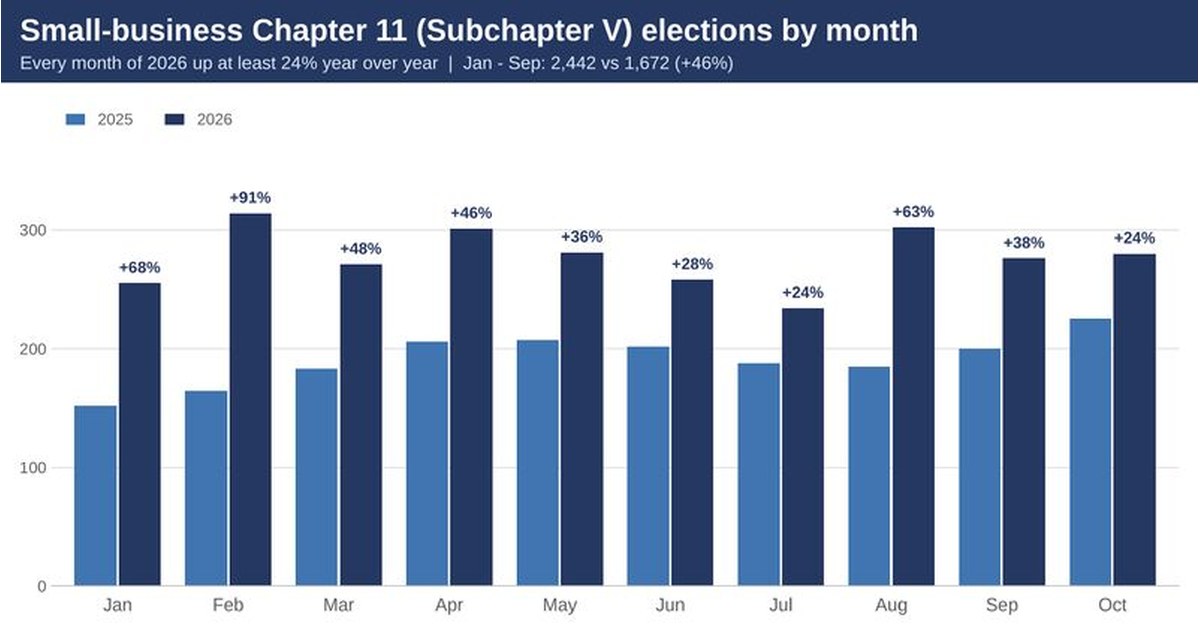
Small business Chapter 11 elections have been up at least 24% year over year in every month of 2026.
Subchapter V, the Chapter 11 track for small businesses, recorded 2,442 elections in the first nine months of 2026, up 46% from 1,672 in the same period of 2025, per Epiq AACER. October added 280, up 24% year over year.
That pressure is showing up in our deal flow, and it raises a question for buyers and investors: when is a distressed small business worth recapitalizing?
Where the pressure comes from
Rates are one pressure point. Many SBA 7(a) loans float with prime, which was 3.25% for most of 2021 and is 7.00% today. On a $3mm floating balance, that 3.75-point increase adds roughly $110k a year of interest.
Bank credit is harder to get. SBA 7(a) approvals fell 28% by count in FY2026, and loans of $500k or less fell the most. We covered that in SBA 7(a) approvals fell 28%.
When bank credit isn't available, some owners turn to merchant cash advances. MCAs can carry triple-digit annualized costs in extreme circumstances. We've reviewed 5 to 10 deals in recent months that included MCAs or a high-cost debt refinancing as a core part of the thesis.
What a fundable recapitalization looks like
The theses in these recapitalizations that hold up typically share most of the following:
- The strain traces to an identifiable event. A one-time shock required financing, rather than the business running ongoing losses.
- Normalized free cash flow covers conventional debt service with room to spare. We look for fixed charge coverage of at least 1.3x to 1.5x. The DSCR has to work on the new capital structure, not the current one.
- The price reflects the situation, and the owner engages before a default. An owner who comes to the table early has more options, and so does the buyer.
When the fundamentals likely aren't there
We've also seen scenarios where the fundamentals likely aren't there:
- Debt service already exceeds free cash flow, and new advances are paying off old ones. That is a funding spiral, not a one-time event.
- Payroll taxes or other obligations are also past due. The strain has spread beyond the lender.
- Paying off the debt alone would result in an unattractive entry multiple for equity investors. If retiring the MCAs and the bank debt pushes the effective price above what comparable businesses close at, the equity is paying for the previous owner's financing decisions. Our comparison of LOI prices with closing multiples is a useful reference for where prices typically land.
What I'd check
If you are looking at a recapitalization, or investing alongside a buyer who is:
- What caused the strain? Ask for the timeline. A single identifiable event is a very different underwriting case from a slow decline.
- What does free cash flow look like normalized? Strip out the one-time costs and the MCA payments, then test fixed charge coverage against conventional debt. Look for 1.3x to 1.5x at a minimum.
- What is everything owed? Include past-due payroll taxes, vendor balances and any other obligations, not just the debt on the balance sheet. Our LP due diligence template is a starting point.
- What is the all-in entry multiple? Add the cost of retiring the debt to the price and compare it with closed-deal multiples for similar businesses.
- When did the owner engage? Before a default, there is room to structure. After one, the lender may be driving the process.
What other cautionary signals are important in these types of recapitalizations? For more deal reviews and co-investment opportunities, join SMB Investor Network at smbinvestornetwork.com.
Sources
- Epiq AACER bankruptcy filing statistics, January–October 2026 and 2025, Subchapter V elections, as also reported by the American Bankruptcy Institute.
- U.S. prime rate, 2021 and November 2026.
- Search Fund Ventures deal reviews, 2026.